
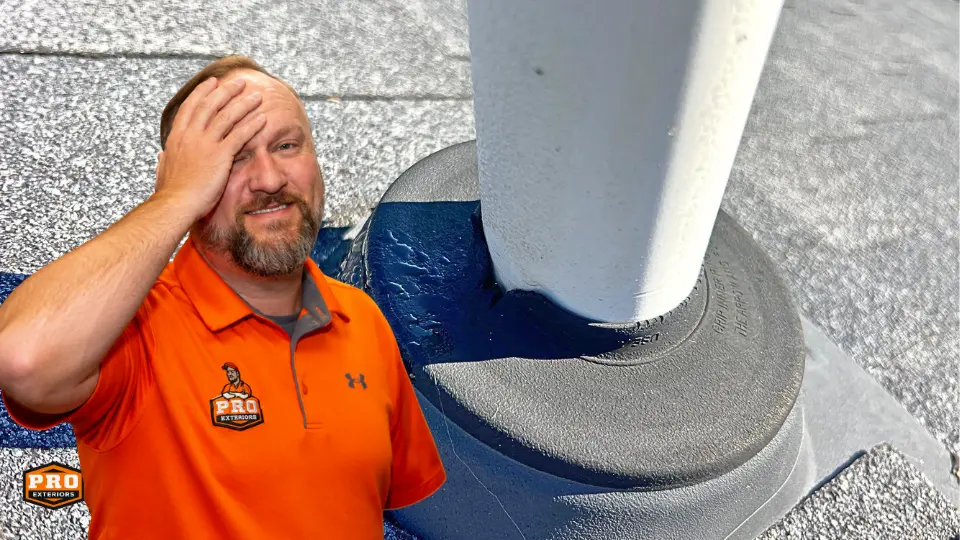
A Roof Can Outlast Its Pipe Boots: Why Flashing Details Matter
Pipe boots can fail well before the end of a shingle roof, even when asphalt shingles carry warranties of 25 to 50 years. Those warranty terms apply to the shingles and depend on the product and coverage details; they do not guarantee that every flashing, seal, or accessory lasts as long. Because pipe boots protect roof openings around plumbing vents, their condition matters for preventing leaks.
A long shingle warranty does not make every roof component last that long
Pipe boots, also called pipe flashings, seal the openings where plumbing vent pipes pass through the roof. They sit in a demanding spot: exposed to sun, rain, wind, temperature swings, and movement around the pipe. The boot and its seal can deteriorate or loosen while the shingles around it still have years of service left.
That means a leak does not always call for a full roof replacement. A failed pipe boot can let water into the roof assembly, stain ceilings, damage insulation or wood, and create a repair need even when the shingles look sound. During a roof inspection, it is worth checking these penetrations and the surrounding shingles, flashing, and seal.
Our preferred pipe boot: Lifetime Tools Ultimate Pipe Flashing
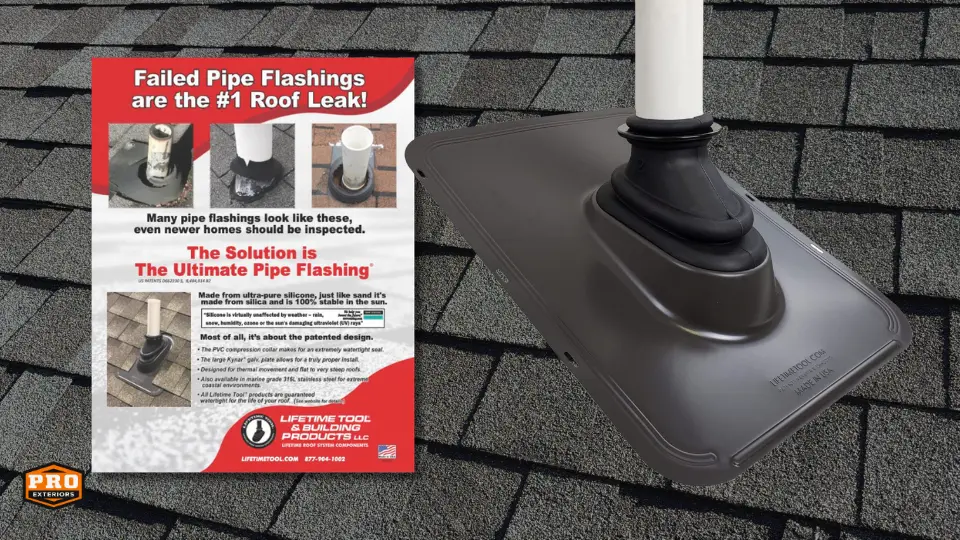
At Pro Exteriors, we prefer the Lifetime Tool® Ultimate Pipe Flashing® for appropriate applications. Its design includes a pure silicone boot and a compression collar intended to help secure the boot around the pipe. The manufacturer provides product specifications and installation guidance, and the correct flashing depends on the pipe material and roofing system.
Like any roof component, performance depends on choosing the right product and installing it according to the manufacturer’s instructions. The Ultimate Pipe Flashing is designed for PVC and ABS plastic pipes; other pipe materials may require an additional compatible adapter or sleeve. Our roofing team can assess the existing pipe and roof before recommending a repair or replacement.
How to spot a failing pipe boot
A pipe boot leak may show up as a ceiling stain, damp insulation, or water marks near a plumbing vent, but water can travel before it becomes visible indoors. On the roof, a roofer may find a cracked or brittle boot, a loose collar, gaps around the pipe, lifted shingle edges, or damaged sealant. These signs call for a closer inspection; a stain alone does not prove the pipe boot is the source.
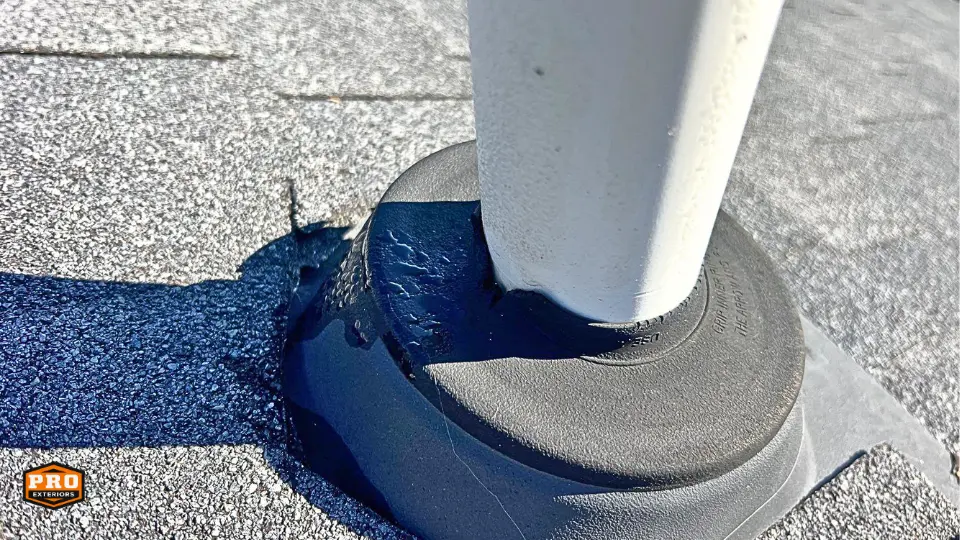
Because a plumbing vent penetrates the roof covering, the repair needs to restore a watertight transition without damaging nearby shingles or underlayment. Repeatedly adding sealant over an aging boot may not address the underlying failure. A qualified roofer can inspect the boot, the pipe, nearby materials, and the path water may be taking before recommending a repair.
Can a pipe boot be replaced without replacing the roof?
Often, yes. If the surrounding shingles and roof deck are in serviceable condition, a roofer may be able to replace a failed pipe flashing as a localized repair. The scope depends on the roof’s age and condition, access, flashing type, pipe material, and whether water has damaged the roof deck or interior. A full replacement may still be appropriate when deterioration is widespread or the roof is near the end of its service life.
During an inspection, ask the roofer to explain what failed, show you the affected area when it is safe to do so, and describe how the replacement flashing will be integrated with the shingles. Ask which product fits the pipe material and whether installation follows the manufacturer’s instructions. A clear explanation helps you compare a targeted pipe boot repair with broader roof work.
Watch Brad’s Waz-Up With That?
In this short episode, Brad discusses the pipe-boot detail and why it deserves attention as part of a complete roofing system.
If your roof has a stain near a plumbing vent, or you are planning a roof replacement, ask your roofer to inspect the pipe flashings along with the shingles. Paying attention to these small transitions can help protect the roof system around them.
Need help with a roof inspection or repair in Delaware or Maryland? Contact Pro Exteriors to talk with our team.

Recent Articles
The Information Hub


Your Best Roofing System Is A Call Away
Experience The PRO Difference
"*" indicates required fields